- 0
- 2,422 words
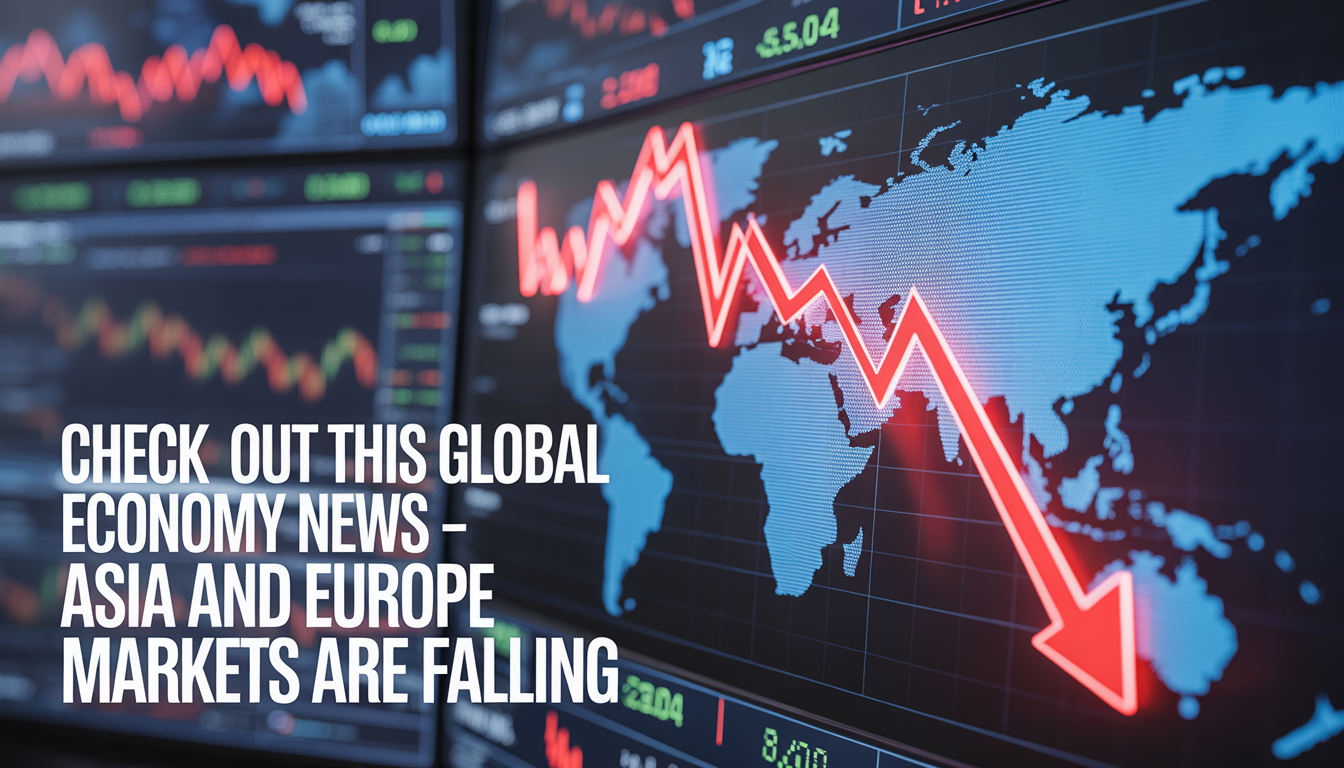
I woke up this morning, checked my portfolio, and for a second, I thought I’d accidentally opened a horror movie script instead of my brokerage app. Everything was red. It wasn’t just “a bad day at the office” red; it was “the ground is lava and the lava is on fire” red. My retirement fund currently looks like it went twelve rounds with a heavyweight boxer, and let’s just say the fund did not win. If you’ve been looking at the markets in Tokyo or London today, you might be considering trading your stocks for something more stable, like bottle caps or magic beans.
The Morning the Screens Bled:
I’ll be honest with you: there is a specific kind of silence that happens when you realize your “safe” investments just took a header off a skyscraper. I was sitting at my kitchen table, the steam from my coffee still rising, and I watched the ticker for the Nikkei 225 scroll past. Down 1.6%. Then I swiped over to the FTSE 100 in London. Down 0.6%. It felt like watching a slow-motion car crash where I was the one in the passenger seat.
We’ve all heard the phrase “When America sneezes, the world catches a cold.” Well, in March 2026, it seems like the Middle East has a fever, and now Asia and Europe are the ones in the ICU. It’s not just numbers on a screen; it’s the collective anxiety of millions of people wondering if their savings are about to evaporate. I spent the better part of three hours digging into the “Why” behind this carnage, and let me tell you, the rabbit hole goes deep. It’s a mix of geopolitical warfare, energy crises, and a sudden realization that the “safe” credit markets might be built on shifting sand.
Asia: The First Domino to Fall:
If you were sleeping while the sun was up in Asia today, you missed a brutal session. The MSCI Asia Pacific Index dropped 1.2%, but that doesn’t even tell the whole story. Japan’s Nikkei 225 was the real casualty, sliding 1.6%. Why? Because Japan is effectively a giant factory that runs on imported energy. When oil hits $100, as it just did again this morning, Japan’s profit margins don’t just shrink; they vanish.
I’ve been reading these reports coming out of Singapore and Tokyo, and the sentiment is “Risk-Off.” That’s investor-speak for “Run for the hills.” People are dumping stocks and piling into the US Dollar and Gold. Even the Yen, which usually acts as a safe haven, is struggling. It hit 159 per dollar today. That’s a level that makes Japanese officials start sweating through their expensive suits.
The most unsettling part of the Asian sell-off isn’t just the price of oil, though. It’s the “Security of Flows.” With the Strait of Hormuz essentially closed right now, through which 20% of the world’s oil flows, companies in Taiwan and South Korea are realizing they might not have enough fuel to keep the lights on in their chip-making factories. When you can’t make chips, you can’t make money. And when you can’t make money, your stock price goes through the floor.
Europe: The Energy Nightmare 2.0:
By the time I finished my second cup of coffee, the European markets had opened, and the news wasn’t any better. The Stoxx Europe 600 fell 0.5% right out of the gate. In London, the FTSE 100 was down 0.6%, and the German DAX, the engine of Europe, slipped 0.4%.
It feels like a bad sequel to the 2022 energy crisis. Back then, it was all about Russian gas. Now, it’s about Middle Eastern oil and LNG. I saw a report this morning that the Ras Laffan LNG facility in Qatar has basically shut down operations because they can’t get ships in or out of the Gulf safely. Europe relies on that gas to heat homes and run industries.
Walking through the research, I found that German industrial orders have cratered, down 11.1%. That’s a “recession is coming” kind of number. If Germany stops building cars and machines, the rest of Europe feels the pull. I think about my friends over in France and Italy who are already complaining about their electricity bills. This market fall is just a reflection of the fact that people are realizing this isn’t a “temporary” glitch. This is a structural shock.
The “Private Credit” Ghost in the Machine:
Now, here is the part of the news that really gave me the chills. It’s a headline most people might skip, but it’s probably the most dangerous thing happening right now. Morgan Stanley and a firm called Cliffwater LLC just “capped withdrawals” on their multibillion-dollar private credit funds.
Translation: People tried to get their money out, and the banks said, “No.”
I remember 2008. I remember when the “liquidity” dried up. When big funds start locking the doors, it means they are worried about the quality of the loans they’ve made. In 2026, the world has a lot of debt, and a lot of that debt is tied up in these private credit markets that aren’t as regulated as the big banks. If this “strain” spreads, we aren’t just looking at a stock market dip; we are looking at a full-blown credit crunch. I’m watching this very closely, because when the “plumbing” of the financial system breaks, everyone gets wet.
The Strait of Hormuz: The Chokepoint of the World:
I spent about two hours this afternoon looking at satellite maps of the Middle East. It’s amazing, and terrifying, how much of our modern life depends on a tiny strip of water between Iran and Oman.
The Iran-Israel war is now entering its second week. Today, there were reports of tankers being attacked in Iraqi waters. When those headlines hit the Bloomberg terminals, the markets didn’t just dip; they shivered. The “Fear Premium” on oil is now about $15 to $20. That means we are paying an extra twenty bucks a barrel just because we are scared of what might happen tomorrow.
I read a piece by an analyst at Saxo Markets who said it perfectly: “This is not just a supply story. It is increasingly about security of flows and transport-cost shock.” It’s one thing if the oil is there; it’s another thing if you can’t get it to where it needs to go.
Why the “Green Transition” Hasn’t Saved Us Yet:
I know what some of you are thinking: “Weren’t we supposed to be using solar and wind by now?” I thought so too. But the reality of March 2026 is that we are in a “Hanging Valley.” We’ve started to move away from oil, but we haven’t built enough of the new stuff to replace it.
I was looking at the latest IEA data, and it turns out that even our “green” industries are oil-dependent. You need diesel to mine the lithium for batteries. You need petroleum to make the plastic for the solar panel housings. When oil goes to $100, the “Cost of Transition” spikes.
It’s a cruel irony. The very thing we are trying to escape, fossil fuels, is getting so expensive that it’s making it harder to afford the escape hatch. I see this in my own life. I want to upgrade to a better EV, but the prices keep climbing because the shipping costs for the components are through the roof.
The Psychological Toll: “Market Fatigue”:
There’s a human side to this that the news anchors don’t talk about. I call it “Market Fatigue.” It’s that feeling when you’ve survived so many “once-in-a-lifetime” crises that you just want to stop checking the news.
I felt it today. I saw the red screens, and my first instinct wasn’t to “buy the dip” or “hedge my position.” It was time to close the laptop and go for a walk. But you can’t walk away from the economy. The falling markets in Asia and Europe are going to affect the price of your groceries next week. They are going to affect whether your company gives you a raise this year.
I’ve noticed that in 2026, we’ve become a bit numb to the chaos. We see $100 oil, and we just sigh. We see the FTSE falling, and we just shrug. But that numbness is dangerous. It means we aren’t preparing for the reality that the “old” way of doing things, relying on stable, globalized trade routes, might be gone for a while.
Gold, Dollars, and the “Flight to Safety”:
When the world feels like it’s falling apart, people go back to the basics. Today, I watched Gold test the $5,300 mark. People are buying bars of yellow metal because they don’t trust the digital numbers on their screens anymore.
And then there’s the US Dollar. The “Greenback” is the haven of choice right now. As Asian and European currencies slide, the Dollar gets stronger. On the surface, that sounds good if you’re in the US, but it actually makes things worse for everyone else. A strong dollar makes oil (which is priced in dollars) even more expensive for a guy in London or a factory owner in Tokyo. It’s a “Vicious Cycle” that keeps feeding the fire.
I looked at Bitcoin today, too. It fell about 1.7%, sitting at around $69,460. For a long time, people said crypto was the “digital gold” that would save us during a war. But right now, Bitcoin is trading just like a tech stock. When the markets get scared, people dump the “risky” stuff, including their Bitcoin, to get their hands on cold, hard cash.
The “Trump Factor” and Market Uncertainty:
I can’t write about the markets in 2026 without mentioning the political elephant in the room. President Trump’s recent comments about the war in Iran being a “short-term excursion” sent a wave of confusion through the trading floors.
One minute, he’s saying he’ll waive oil sanctions to bring prices down. The next minute, he’s talking about the US Navy escorting tankers through the Strait. Markets hate uncertainty. They would rather have bad news than “unknown” news. Every time a new headline comes out of Doral or the White House, the algorithms go crazy. I sat there today watching a five-minute candle on the S&P 500 futures jump up and down like a heart monitor. It’s exhausting to watch, and it makes it impossible for regular people like us to plan for the future.
My Strategy (Such as it Is):
So, what am I doing while the world’s markets are doing their best impression of a sinking ship?
Honestly? I’m holding my breath. I’m not selling anything because selling in a panic is the fastest way to lock in a loss. But I’m also not “buying the dip” yet. I think we have further to fall. When you have ships burning in the Gulf and banks locking their doors, you don’t go looking for bargains. You go looking for a life jacket.
I’m focusing on “Liquid Cash” right now. I’m making sure I have enough in a high-yield savings account (even though the “high yield” feels like a joke compared to inflation) just in case the credit crunch gets worse. I’m also looking at “Defensive” stocks, utilities, healthcare, and basic food producers. People still need to eat and turn on the lights, even if the world is in a mess.
The Global Domino Effect: Why It Matters to You:
It’s easy to think, “Why should I care if the Nikkei 225 fell 1.6% in Japan? I live in Kansas.”
But the global economy is like a giant spiderweb. You pull one thread in Tokyo, and the whole thing shakes in Wichita. The companies that make your car, your phone, and your medication are all listed on these global exchanges. When their stock price falls, they stop investing. They stop hiring. They start cutting costs.
Today’s fall in Asia and Europe is a “Warning Shot.” It’s telling us that the cost of doing business globally just went up. It’s telling us that the “Peace Dividend” we’ve enjoyed for decades is officially over. We are moving into a “High Friction” world where everything is harder, slower, and more expensive.
Conclusion:
As I wrap this up, the sun is setting, and the markets are still looking pretty bleak. I don’t have a crystal ball. I don’t know if tomorrow will bring a rebound or another “Red Morning.”
But I do know that being informed is the only way to keep your head above water. Don’t just look at the headlines; look at the “Why.” Understand the connection between a drone in Iraq and the price of your mutual fund. It won’t make the losses hurt any less, but it will help you make better decisions for your family.
For now, I’m going to go make another cup of coffee and try to find a news story that isn’t about a falling index. Maybe I’ll look up some bread recipes. At least I can control the rise of my dough, even if I can’t control the rise of oil.
FAQs:
1. Why are the Asian markets falling today?
A combination of $100 oil, the closure of the Strait of Hormuz, and Japan’s high energy-import dependency.
2. What is the “Private Credit” strain I keep hearing about?
Major firms like Morgan Stanley have capped withdrawals, sparking fears that high-interest-rate loans are starting to fail.
3. Is Europe entering a recession in 2026?
With German industrial orders falling 11.1% and energy prices surging, many analysts believe a recession is now inevitable.
4. Why is the US Dollar getting stronger if the economy is messy?
The Dollar is seen as the “world’s piggy bank,” so investors rush to it for safety when global markets crash.
5. Should I sell my stocks right now?
Most financial advisors suggest staying calm and not selling in a panic, but every personal situation is different.
6. How does the Strait of Hormuz affect my local stock market?
Since 20% of the world’s oil passes through it, any disruption causes a global “energy tax” that kills corporate profits.
7. Is Bitcoin a safe haven in this 2026 market?
Currently, Bitcoin is behaving more like a risky tech stock than a safe haven, falling alongside traditional markets.
Author

officeworks1419@gmail.com