- 0
- 3,613 words
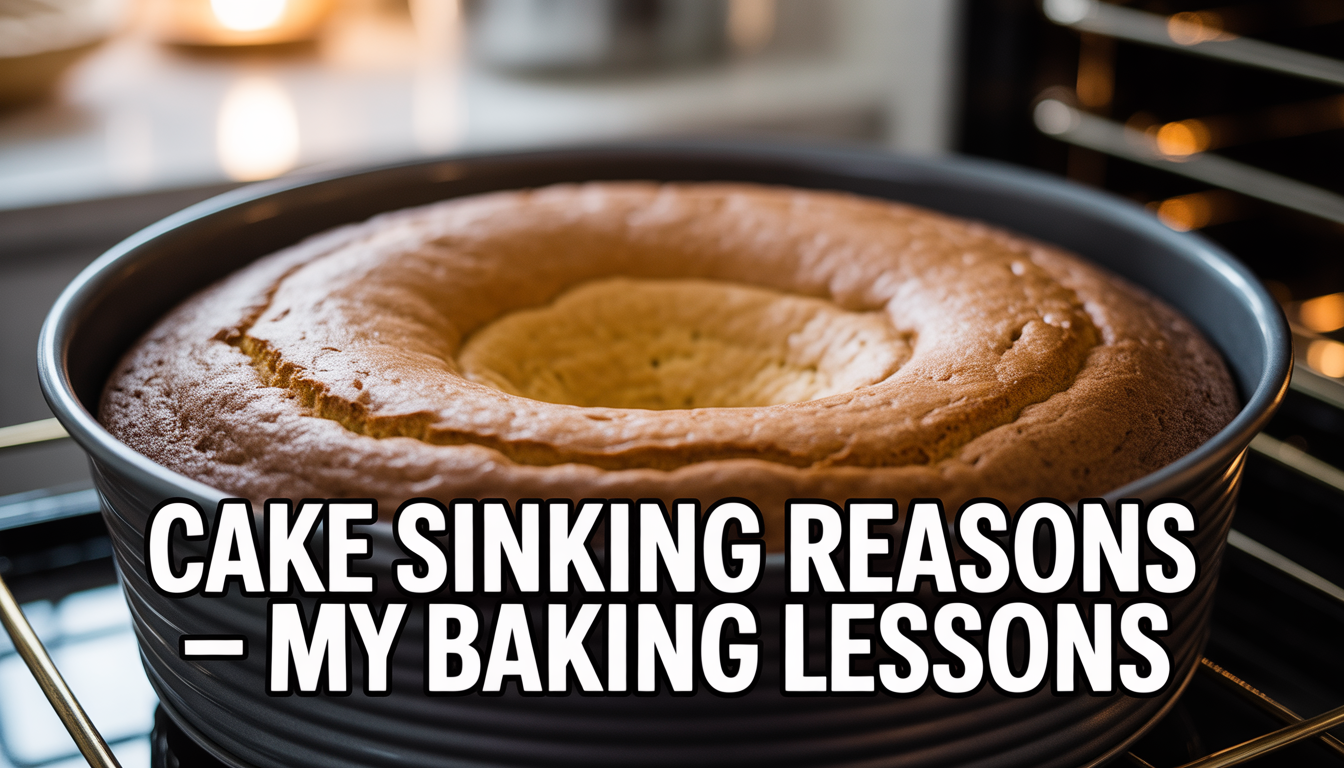
I once made a chocolate cake for my mom’s birthday that looked like a giant brown bowl. I followed the recipe, I wore my lucky apron, and I even sang a little song to the batter, but when I pulled it out of the oven, the middle just gave up on life. It didn’t just sink, it plummeted like it was trying to escape through the bottom of the pan. I ended up filling the hole with about two pounds of whipped cream and pretending it was a “new style” of cake, but inside, I was heartbroken. That was the day I decided to stop guessing and actually learn the Cake Sinking Reasons that were haunting my kitchen.
The Day the Center Fell Out:
I remember standing in my kitchen, staring at that “bowl” cake and feeling like a total failure. I had spent hours on it. I used the expensive cocoa powder. I even hand-whisked the frosting. But none of that mattered because the cake itself had a giant crater in the middle. My mom was very sweet about it, she said it was the best “cake-soup” she ever had, but I knew better.
I realized then that baking isn’t just about mixing things in a bowl. It is a bit like a magic trick where everything has to happen at exactly the right time. If one thing goes wrong, the whole trick falls apart. I spent the next six months turning my kitchen into a lab. I made cakes that were too dry, cakes that were too wet, and a lot more cakes that sank. Through all those Baking Lessons, I finally figured out why my cakes were giving up on me.
The Curiosity Trap:
This is the mistake I made more than any other. I am a very curious person. I want to know what is happening inside the oven. I want to see the cake growing. So, I would pull the door open every ten minutes to take a peek.
When you open the oven door, two bad things happen. First, the Oven Temperature drops fast. Even a few seconds of an open door can let out all the heat. Second, you are letting a blast of cold air hit a cake that is still mostly liquid.
Think of a cake like a balloon. The heat makes the bubbles grow. If you hit those hot bubbles with cold air before they are strong enough to hold their shape, they pop. Once those bubbles pop, they can’t grow back. The middle of the cake, which is the last part to get hot, just falls. This is one of the most common cake-sinking reasons. Now, I have a strict “no peeking” rule. I keep the light on and look through the glass like a spy, but I never, ever open that door until the timer goes off.
The Secret Power of the Bubbles:
To understand why a cake stays up, you have to think about the bubbles. When you put Baking Powder or Baking Soda into your batter, you are creating tiny pockets of air. As the cake gets hot, those pockets expand.
If your Baking Powder is old, it won’t have the strength to push the batter up. I used to keep my powder in the back of the pantry for years. I thought if it looked white and powdery, it was fine. I was wrong. These ingredients lose their “magic” over time.
I learned a cool trick to check if my powder is still good. I put a little bit in a cup of hot water. If it fizzes like crazy, it is ready to work. If it just sits there, I throw it away. Using fresh ingredients is one of the best Baking Tips I can give you. A cake is only as strong as the bubbles inside it.
The Over-Mixing Mistake:
I used to think that the more I stirred the batter, the better the cake would be. I wanted it to be perfectly smooth with zero lumps. But I didn’t realize that I was actually hurting the Cake Structure.
When you mix flour with wet things, you create something called gluten. Gluten is like the “glue” of the cake. A little bit is good because it holds the cake together. But if you stir too much, that glue gets too strong and stretchy.
Also, when you are Over-mixing Batter, you are pushing too much air into it. You might think more air is good, but if there is too much air, the bubbles get too big. They grow too fast in the oven, and then they pop because the “glue” around them isn’t strong enough yet. Now, I mix my batter just until I can’t see the white flour anymore, and then I stop. It feels weird to leave a few tiny lumps, but my cakes stay tall and proud because of it.
The Temperature of Your Ingredients:
For a long time, I took eggs and butter straight from the fridge and threw them into the mixer. I didn’t have time to wait. But I noticed my cakes were coming out lumpy and sinking in the middle.
I learned that using Room Temperature Ingredients is a total game-changer. When your butter and eggs are at the same temperature, they mix together into a smooth cream. This cream can hold onto tiny air bubbles much better than cold, chunky butter can.
If your ingredients are cold, they won’t bond together correctly. In the oven, the fat will melt too fast, and the air bubbles will escape before the cake has a chance to bake around them. Now, I take my eggs and butter out an hour before I start. If I am in a rush, I put my eggs in a bowl of warm water for a few minutes. It is a small step, but it is one of those Baking Lessons that makes a huge difference.
My Fight with the Oven Thermometer:
I used to trust my oven. I would set it to 350 degrees and assume it was actually 350 degrees. But after many failed cakes, I bought a cheap oven thermometer to put inside.
I was shocked to find out that when my oven said it was ready, it was actually 30 degrees too cold. If the Oven Temperature is too low, the cake will rise very slowly. The bubbles will get big, but the cake won’t “set” or get firm in time to hold them up. By the time the cake is supposed to be done, the middle is still mushy, and it just collapses.
On the other hand, if the oven is too hot, the cake rises too fast, gets a big peak, and then falls once you take it out. Knowing the true temperature of your oven is vital. It is one of the most important parts of successful Blogging about recipes because if I give you a temperature and your oven is lying, my recipe won’t work for you.
The “Almost Done” Problem:
Have you ever taken a cake out because it looked perfect on the outside, only to have it sink five minutes later? I call this the “Almost Done” trap. The outside of the cake is the first part to get hot and firm. The middle takes much longer.
If you take the cake out too early, the middle hasn’t had time to turn from a liquid to a solid. The heat is what makes the flour and eggs create a strong wall around the air bubbles. If you pull it out while that wall is still soft, gravity will win every time.
I now use a wooden toothpick to check the middle. If it comes out with wet batter on it, the cake stays in. If it comes out clean, the cake is ready. Under-baking is a leading cause of a sunken center. It is better to have a slightly dry cake that stays up than a moist cake that looks like a crater.
Measuring by Weight vs. Volume:
I used to use measuring cups for everything. I would scoop the flour and tap the cup on the counter to level it off. But I learned that I was actually packing the flour down. I was using way more flour than the recipe called for.
Too much flour makes a cake heavy, but too little flour means the cake doesn’t have enough “bones” to hold itself up. I switched to using a digital kitchen scale, and it changed my life. Measuring in grams is much more accurate. It ensures that my Cake Structure is perfect every single time.
Baking is like a chemistry experiment. If you have too much sugar, it breaks down the structure. If you have too much liquid, it weighs the bubbles down. Precise measuring is one of those Baking Lessons that turns a hobby into a skill.
The Role of Sugar and Fat:
We all love sugar and butter, but too much of a good thing can be a disaster for a cake. Sugar doesn’t just make things sweet, it also makes things soft. If a recipe has too much sugar, the “walls” of the cake stay too soft for too long. They can’t hold up the weight of the cake, and the whole thing sinks.
The same goes for oil or butter. I once thought adding extra oil would make my cake “super moist.” Instead, it made it super flat. The extra weight of the oil was too much for the air bubbles to lift. Following the recipe exactly, especially when it comes to the ratio of sugar to flour, is one of the best Cake Sinking Reasons to keep in mind.
The Importance of the Right Pan:
I once tried to bake a huge amount of batter in a pan that was way too small. I thought it would just make a very tall cake. Instead, the cake rose over the edges, lost its support, and the middle fell in like a crushed soda can.
The size of your pan matters because it changes how the heat gets to the middle of the cake. If the pan is too deep, the edges will burn before the middle is cooked. If the pan is too wide, the cake will be thin and won’t have enough “push” to stay up. I always use the size mentioned in the recipe. If I have extra batter, I just make a few cupcakes. It is much better than ruining the whole cake.
Cooling a Cake: The Final Test:
You might think that once the cake is out of the oven, the hard part is over. I used to think that too. I would take my hot cake and put it right on the counter, sometimes even in front of an open window, to “speed it up.”
But a hot cake is still very fragile. If you move it too much or expose it to a cold draft, it can still sink. Cooling a Cake slowly is very important. I leave mine in the pan for about ten minutes on a wire rack. The rack lets air move under the pan so it cools evenly.
If you leave it in the pan too long, it gets soggy from the steam. If you take it out too soon, it might break or slump. It is all about finding that middle ground. Patience is one of the hardest Baking Lessons to learn, but it is the one that saves your hard work at the very end.
The Elevation Secret:
I lived in the mountains for a few years, and I couldn’t figure out why my favorite recipes were suddenly failing. My cakes were rising like crazy and then falling flat as a pancake.
I found out that at high altitudes, there is less air pressure. This means the air bubbles in the cake grow much faster and much bigger than they do at sea level. Because they grow so fast, they pop before the cake is firm.
I had to learn how to change my recipes for the mountains. I had to use less Baking Powder and more liquid. It was a whole new set of Baking Tips to learn. If you live somewhere high up, your Cake Sinking Reasons might just be the air itself!
Why I Love My Failures:
Looking back at my “bowl” cake, I’m actually glad it happened. If it had been perfect, I never would have spent the time learning the “why” behind baking. I would just be following instructions without understanding them.
Now, when I bake, I feel like I’m in control. I know why I’m waiting for the eggs to get to room temperature. I know why I’m not opening the oven door. I know why I’m weighing my flour. This knowledge has made me a much better baker, and it has made my cakes taste much better, too.
Every mistake is just a lesson in disguise. If your cake sinks today, don’t throw it out. Fill it with fruit, cover it with frosting, and eat it while you plan your next one. That is the true spirit of Sustainable Living in the kitchen, not wasting food just because it doesn’t look like a picture.
The Science of the “Set”:
I want to talk a little more about what happens when a cake “sets.” Inside the oven, the eggs in your batter start to get firm, just like when you fry an egg in a pan. At the same time, the starch in the flour soaks up liquid and gets strong.
This happens from the outside in. If you pull the cake out before the center reaches about 210 degrees, that center hasn’t “set” yet. It is still just a bunch of hot bubbles held together by liquid. As soon as the cool air hits it, the bubbles shrink, and because there is no solid “wall” to hold them up, the whole center drops.
This is why Under-baking is so dangerous. It doesn’t matter how well you mixed it or how fresh your powder was if you don’t give the cake enough time to build its skeleton.
Using the Right Flour:
Not all flour is the same. I once used bread flour for a cake because I ran out of all-purpose flour. The cake was so tough I could have used it as a brick to build a wall.
Bread flour has a lot of protein, which makes a lot of gluten. Cake flour has very little protein, which makes a very soft cake. If you use the wrong one, your Cake Structure will be all wrong. A cake with too little protein might not be strong enough to stay up, while a cake with too much will be rubbery. Most recipes use all-purpose flour because it is right in the middle. If a recipe specifically asks for cake flour, there is a good reason for it!
The Humidity Factor:
Believe it or not, the weather can affect your cake. On a very rainy, humid day, your flour can actually soak up moisture from the air. This means you might be adding more liquid to your cake than you realize.
I noticed that on rainy days, my cakes tended to be a bit more slumped. Now, if it is pouring rain, I might add a tiny bit more flour or bake the cake for a few extra minutes to make sure the extra moisture evaporates. It is a small detail, but being a Professional Content Writer in the food niche means paying attention to these tiny things that others might miss.
The “Over-Leavening” Trap:
Sometimes we think that if one teaspoon of Baking Powder is good, then two must be better! We want our cake to be extra fluffy.
But if you add too much, the cake rises way too high, way too fast. It becomes like a giant balloon that is stretched too thin. Eventually, the balloon pops. When it pops, it doesn’t just go back to normal size, it crashes down.
I learned to be very careful with my leavening agents. I use level spoons, and I never “add a little extra for good luck.” The chemistry of the recipe is already balanced. My job is just to follow it.
The Sound of a Done Cake:
Did you know you can listen to a cake? This is one of my favorite Baking Tips. If you put your ear near the cake, a cake that isn’t done will make a loud “sizzling” or “bubbling” sound. This is the sound of moisture leaving the batter.
As the cake gets closer to being done, the sound gets quieter. A perfectly baked cake will be almost silent. I don’t recommend putting your face in the hot oven, of course, but once you pull it out to check it, give it a listen. It is a fun way to connect with your food and learn the signs of a finished bake.
The Bounce Test:
Another way I check my cakes is the “bounce test.” I gently press the center of the cake with my finger. If it stays indented like a piece of play-dough, it isn’t done. If it springs back immediately, it means the Cake Structure is strong, and the cake is ready to come out.
This is often more reliable than the toothpick test because sometimes a toothpick can come out clean even if the structure hasn’t fully set yet. Between the toothpick, the sound, and the bounce, I have a triple-check system that never fails me now.
Fixing a Sunken Cake:
If you followed all my advice and your cake still sank, don’t panic! It happens to the best of us. I have learned some great ways to save a “crater” cake.
You can scoop out the middle and fill it with fresh berries and whipped cream. You can crumble the cake up and mix it with frosting to make cake pops. Or, you can just cut the cake into layers and use extra frosting to level it out. No one has to know it wasn’t perfect. At the end of the day, it is still cake, and it still tastes amazing.
My Journey Continues:
Even now, after years of baking, I still learn new things. Every time I try a new recipe or a new type of flour, I am adding to my Baking Lessons.
Baking is a journey, not a destination. It is about the smell of the kitchen on a Sunday afternoon and the look on a friend’s face when you give them a slice of something homemade. The Cake Sinking Reasons I found were just bumps in the road. They made me more patient, more observant, and much more appreciative of a perfectly tall, fluffy sponge.
Why I Share These Stories:
I share my baking disasters because I want you to know that it is okay to mess up. The internet is full of perfect pictures, but behind every perfect picture is a kitchen that was once covered in flour and a baker who once cried over a flat cake.
By being honest about my “bowl” cake, I hope I can save you from the same frustration. Sustainable Living is about being kind to yourself and learning from your environment. Your kitchen is a place of growth, both for your cakes and for you.
The Joy of the Perfect Bake:
There is no feeling quite like pulling a cake out of the oven and seeing it perfectly level, golden brown, and smelling like heaven. When you know you did everything right, the victory tastes even sweeter.
I hope these Baking Tips help you reach that feeling more often. Whether you are making a simple vanilla sponge or a complex chocolate layer cake, the rules are the same. Respect the bubbles, trust your thermometer, and keep that oven door closed!
Conclusion:
Cakes sink for many reasons, from cold eggs to a lying oven, but every single one of those problems can be fixed. Once you understand the “why” behind the sinkhole, you can bake with confidence. Don’t let a flat cake stop you from enjoying the magic of baking. Just learn the lesson, grab your scale, and try again. Your next masterpiece is just one bake away.
FAQs:
1. Can I fix a cake that has already sunk in the oven?
No, once the bubbles have popped and the structure has fallen, you cannot make it rise again.
2. Why did my cake sink only after I took it out of the oven?
This usually means the cake was slightly under-baked, and the middle wasn’t strong enough to hold its weight.
3. Is it okay to use expired baking powder if I use more of it?
No, expired powder won’t work correctly, no matter how much you use, so it is better to buy fresh.
4. Does the type of sugar I use affect the cake sinking?
Yes, using too much sugar or a very heavy sugar can weigh down the air bubbles and cause a collapse.
5. Why does my cake always sink in the exact same spot?
Your oven might have a “cold spot,” so try rotating your pan halfway through the baking time next time.
6. Can over-greasing the pan cause a cake to sink?
Yes, if the sides are too slippery, the cake can’t “climb” the walls of the pan and might fall back down.
Author

officeworks1419@gmail.com
Related Posts
5 Sugar Alternatives Cooking Hacks For Holiday Baking
- 0
- 3,476 words
Last December, I ate so much gingerbread dough that I actually started to vibrate. I wasn’t just “full”, I was a human...
Read out all